

History doesn’t repeat itself exactly, but the Bay Area and Pacific Northwest have a remarkable tendency to rhyme.
Microsoft transformed Seattle’s Eastside during the 1990s, creating extraordinary personal wealth and affluent neighborhoods. Amazon accelerated that transformation, reshaping Seattle and Bellevue’s skylines and producing another generation of technology millionaires.
Now, a third economic transformation is emerging. Its epicenter is San Francisco. Its engine is artificial intelligence. And its potential impact on Puget Sound real estate could be profound.
We’re calling it the “West Coast wealth wave.”
The next real estate boom may begin on Wall Street, not Main Street
With Anthropic’s imminent IPO and OpenAI commanding extraordinary private-market valuations, an intriguing question emerges: What happens when billions of dollars in employee equity become liquid?
According to figures attributed to Oxford Economics’ 2026 Global Cities Index, San Jose already ranks first globally in GDP per capita at $238,700, followed by San Francisco at $181,889, with Seattle fifth at $152,030.
While economic output isn’t personal wealth, these rankings illustrate the extraordinary productivity concentrated in America’s technology corridors.
Redfin has modeled approximately $198 billion in potential after-tax employee equity associated with OpenAI and Anthropic under hypothetical IPO assumptions (equivalent to roughly 29% of San Francisco’s estimated residential housing value).
That’s not a housing demand forecast, but it illustrates the magnitude of potential purchasing power. And the wealth effect may begin before the IPOs.
San Francisco is already feeling the wealth effect
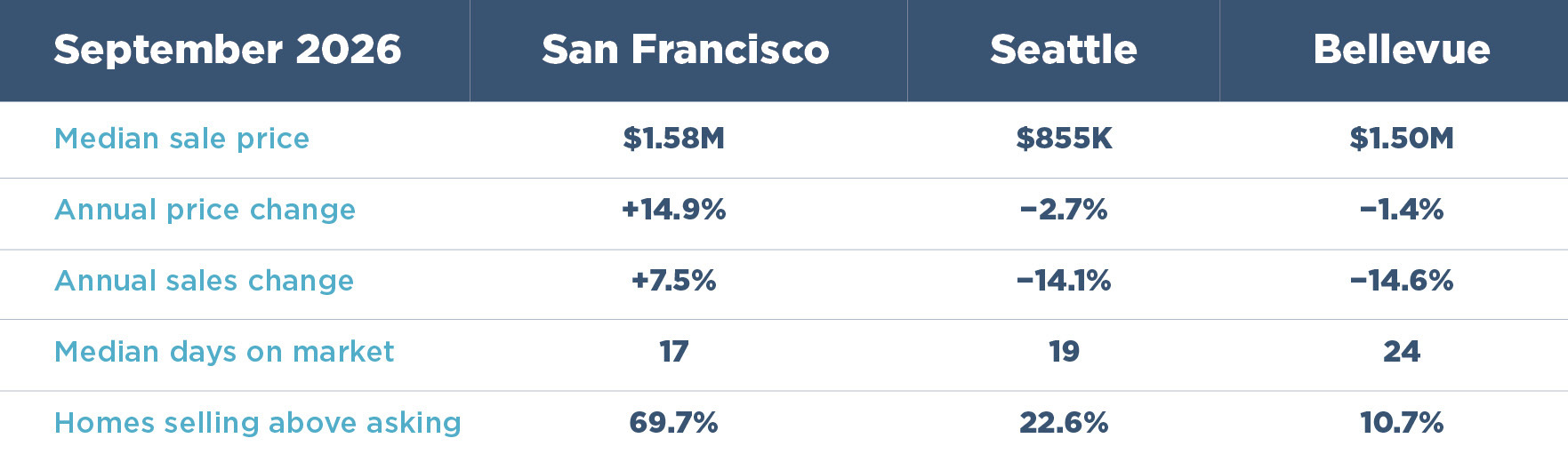
San Francisco’s September 2026 housing statistics suggest an extraordinary residential resurgence is underway.
According to a Redfin-based comparative dataset, median residential prices reached $1.58 million, up 14.9% year over year, representing nearly $205,000 in annual appreciation.
Residential closings increased 7.5% to 1,411 transactions, while median marketing times contracted from 26 days to just 17. Perhaps most remarkably, 69.7% of homes sold above asking price, compared with 49.7% one year earlier.
Nearly seven out of 10 homes are selling above asking. More homes are selling, buyers are acting faster and competitive bidding is intensifying.
Some buyers aren’t waiting for liquidity events. They’re leveraging substantial compensation packages, secondary equity transactions and specialized financing against private-company shares.
The residential wealth effect may already be taking shape — and it isn’t confined to California.
The Silicon Forest is receiving the ripples
Seattle and Bellevue won’t have to wait for wealthy Californians to relocate. The companies creating this next generation of technology wealth are already expanding here.
OpenAI has reportedly committed more than 272,000 square feet in Bellevue, while Anthropic has secured approximately 113,000 square feet in Seattle. Databricks has committed more than 270,000 square feet in Bellevue, alongside Snowflake and other expanding AI employers.
These companies follow a familiar migration pattern established by Google, Meta, Apple and Salesforce.
According to CBRE, Seattle ranks second in North America for technology talent, supporting approximately 213,000 technology workers, including more than 41,000 AI-related professionals.
The office market is also showing signs of stabilization.
CBRE reported approximately 514,000 square feet of positive regional net absorption in the third quarter of 2026, including roughly 300,000 square feet downtown — its first positive quarter since 2021.
Vacancy remains elevated, but the direction deserves attention. First come the leases. Then the employees. Eventually, the equity wealth and potentially the home purchases. That’s a familiar sequence in technology-driven housing markets, just as San Francisco demonstrates.
A tale of two housing markets
The September 2026 residential data reveal a striking divergence between San Francisco and Seattle/Bellevue.
San Francisco is experiencing rising prices, increasing sales and heightened competition. Seattle and Bellevue, meanwhile, are experiencing softer prices, declining transaction volumes and comparatively favorable conditions for buyers.
The contrast is especially revealing between San Francisco and Bellevue, where median home prices are relatively comparable, yet competitive conditions differ dramatically.
San Francisco’s share of homes selling above asking is more than six times Bellevue’s.
These are two major technology centers experiencing very different stages of their residential market cycles.
But for how long?
Today’s market may be tomorrow’s opportunity
For savvy residential brokers and patient consumers, this divergence offers more than an interesting comparison. It may provide a preview of what’s coming.
San Francisco could be the harbinger market, revealing the early effects of an AI-driven wealth cycle that has yet to fully manifest in the Pacific Northwest.
While Bay Area buyers are increasingly competing for limited opportunities, Seattle and Bellevue offer relatively greater negotiating leverage, softer pricing and less competition.
If the West Coast Wealth Wave continues north, today’s opportunity to buy the dip may prove especially compelling in hindsight.
After all, tomorrow’s millionaires may already be living and working here. Their equity simply hasn’t become liquid yet.
Recent high-profile King County transactions suggest technology wealth is influencing luxury housing, including entrepreneurs exiting Bay Area startups and choosing to reinvest and launch new ventures in the Pacific Northwest.
The next wave of buyers may not be relocating for jobs. They may already have them. And real estate markets can respond to wealth creation before its full economic impact becomes obvious.
The question isn’t whether Seattle and Bellevue will replicate San Francisco’s trajectory, but whether those recognizing the early signals will be best positioned if prosperity comes ashore.
What about Washington’s Millionaires Tax?
Washington’s enacted 9.9% tax on qualifying annual individual income above $1 million, scheduled for 2028, introduces uncertainty. Initiative 26-645 seeks repeal.
Tax policy matters, particularly when California’s top marginal personal income tax rate reaches 13.3%. But employment opportunities, schools, lifestyle, recreation and housing quality also influence relocation decisions.
Whatever the political outcome, the Pacific Northwest’s established technology ecosystem isn’t disappearing.
Read the swell before the shoreline changes
Another technology boom isn’t guaranteed.
AI valuations could retreat. IPOs could be delayed. Hiring could disappoint. Mortgage rates and consumer confidence will continue influencing housing demand.
But the leading indicators deserve attention: technology employment, office occupancy, equity liquidity, luxury sales, inventory absorption and relocation trends.
The next real estate recovery may emerge gradually; one commercial lease, one employee, one equity transaction and one home purchase at a time. We’ve seen this movie before with Microsoft and Amazon.
Artificial intelligence may be the new-new economy, and while its epicenter is the Bay Area, its influence is already extending into the Silicon Forest. San Francisco may be providing the surf report for the Puget Sound region.
Perhaps the most provocative possibility is that our next real estate cycle is forming while much of the industry remains focused on the last downturn.
The ripples are already arriving.
Dean Jones is the president and CEO at Realogics Sotheby’s International Realty. This article was written in collaboration with The Futurecast Forum.