
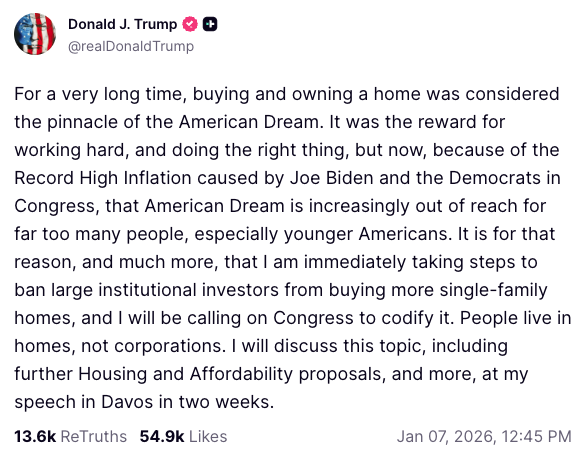
President Trump’s pledge to ban large investment firms from buying single-family homes dinged the stock prices of some of the biggest institutional landlords, but the impact it would have on the housing affordability crisis is debatable.
Observers noted that major investors like Blackstone, Invitations Homes and American Homes 4 Rent own only about 1% of the single-family homes in the United States, and their holdings are concentrated in the South and Sunbelt, so the impact on overall U.S. home prices would vary widely by geography. Additionally, in the markets with relatively high concentrations of institutional ownership, home prices are already declining.
“The administration’s proposed ban on large institutional investors buying single-family homes aims to curb Wall Street’s role in housing, but evidence shows little connection between institutional ownership and affordability,” Jonathan Miller, president and CEO of property appraisal firm Miller Samuel, wrote in his HousingNotes blog.
“Their holdings are concentrated mostly in the South and Sunbelt, where inventory is relatively high and home prices have actually fallen, undermining claims that these investors drive housing costs higher. With most investor-owned homes held by small, local landlords, the proposed restriction is unlikely to meaningfully improve affordability or housing supply.”
Nevertheless, others expressed optimism that a ban would indeed have an impact in markets with high levels of institutional ownership.
“Because the Dallas–Fort Worth market has long been a hotspot for institutional ownership, any new restrictions from the Trump administration would likely be felt here sooner and more acutely than in markets with lower investor activity,” said Todd Luong of REMAX DFW Associates. “In many price ranges, especially entry-level and mid-priced homes, buyers have been competing against all-cash offers from large investment groups. Reducing that competition could give local buyers a better chance to secure a home with less pressure and more favorable pricing.”
Details about the ban have been scarce, and many questions remain. In a post on his Truth Social site announcing the proposed ban, Trump said, “I am immediately taking steps to ban large institutional investors from buying more single-family homes, and I will be calling on Congress to codify it. People live in homes, not corporations.”
He added that he would provide more information on the proposal when he speaks at the upcoming World Economic Forum in Davos, Switzerland, in two weeks.
In a subsequent post, Trump said he would instruct Fannie Mae and Freddie Mac to use a purported $200 million in cash holdings to purchase mortgage bonds to bring mortgage rates down.
Timing of that proposal is everything, according to Victor Kuznetsov, managing director and co-founder of Imperial Fund Asset Management.
“In the short term, expect mortgage rates to level tighter than 2025 averages, but investment bank researchers tend to agree that most of these [mortgage-backed security] purchases have already been priced into rates, so the timing of the [government-sponsored enterprises’] MBS purchases will be important,” Kuznetsov said. “Will the GSEs purchase $200 [billion] over 2026’s calendar year, spreading out the tightening effects over a full year? Details on deployment timing have been sparse so far.”
According to the housing blog ResiClub, the most significant questions about the ban include:
- What constitutes an “institutional investor”?
- Would the investors be required to sell existing properties, or would they just be prohibited from purchasing additional ones?
- Would the ban apply to existing properties scattered throughout a market, or also to build-to-rent development?
- What would happen to existing tenants if the owners were forced to sell their homes?
In the end, industry observers agree that the ban would have a limited effect on overall housing affordability, and the key to bringing down costs is by increasing inventory.
“The first thing to do is build more housing starting now,” Miller said.